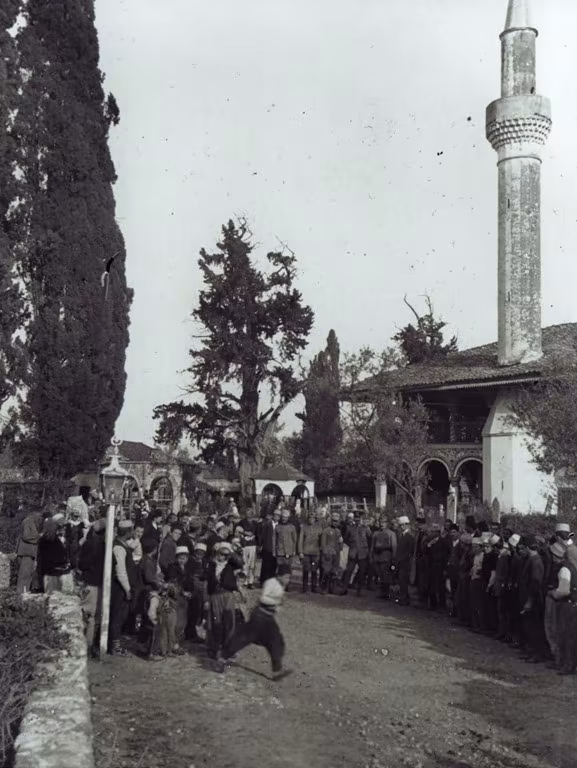
The legend of the Sulejman Pasha Mosque traces its roots back to the Ottoman era, taking its name from the ethnic Albanian Ottoman general Sulejman Bargjini, also known as Berkinzâde Sulejman Pasha, who earned the title of Gazi fighting against the Safavids in Persia. Historical accounts note that the mosque was completed in 1614 CE, serving as the nucleus around which the surrounding streets and the city of Tirana developed.
The commission and foundation of the complex were tied directly to the city's founder, who established not only the house of worship but also a hammam and a bakery in its immediate vicinity. These institutions anchored the early urban layout, providing essential civic functions for the growing populace.
Architecturally, the Old Mosque was celebrated for its beautiful minaret and intricate fresco paintings. Its striking aesthetic stood in notable rivalry with the Et'hem Bey Mosque, which was founded in 1793 by Molla Bey—a descendant of Sulejman Pasha—and later finished by his son Haxhi Etëhem Bey Mollaj.
Functionally, the mosque and its surrounding neighborhood formed the beating heart of daily community life. Adjacent to the Sulejman Pasha Mosque stood the Tomb of Sulejman Pasha, while the Kapllan Pasha Tomb was situated within the exact same neighborhood, binding spiritual memory closely to the urban landscape.
Damage to the historic monument came during the turmoil of World War II, when it was partially destroyed in November 1944. Despite funds collected by the people of Tirana who wished to rebuild their cherished landmark, the remaining structure and its defiant minaret were razed the following year.
Change over time took a definitive and destructive turn under the Communist rule of Enver Hoxha. In 1949, the former mosque site and surrounding historic streets were completely cleared to make space for socialist-era structures, including the Statue of the Unknown Soldier.
What a visitor encounters today on the site is an urban landscape stripped of any physical trace of the mosque. While other religious structures in the area have seen restoration, there remain no plans for the reconstruction of Tirana's founding house of prayer.
Wikimedia research dossier · Last checked: 2026-09-25 16:28:19


